- Home
- SF Travel Tips
- Bay Area Earthquakes
Bay Area Earthquakes:
What visitors to San Francisco should know

Should visitors to San Francisco be concerned about it, or shrug it off like many of the locals do?
Here's what I think visitors to San Francisco need to know about Bay Area earthquakes: safety tips, warning apps, and playing the odds!
Plus some information about the earthquake history of the Bay Area, what the local earthquake faults are like, and what we can expect in the way of future earthquakes.
My earthquake experience in the 1989 Loma Prieta quake.
Earthquake risk takeaway for SF visitors:
- The odds of being present in SF when the Big One hits (1906-type earthquake) are extremely small. There's a 4% chance of it happening at some time in the next 20 years, so if you are in SF for only a week, it's close to a zero likelihood of you being here when it hits (0.004% to be exact).
- The odds of being present in SF when a 6.7 level earthquake hits (1989 Loma Prieta) are also extremely small. For residents, it's almost a sure thing if they spend the next 20 years in the city (a 72% chance). But if you're only here for a few days, the likelihood is tiny that it will happen when you're here. How tiny? If you're in SF for a week, the odds are about 0.12% of it happening while you are here. (Based on it happening on one of those 7 days out of the 7,120 days in 20 years, at a 72% likelihood for that time period.)
 The San Andreas fault off SF...waiting. Not happy.
What visitors to San Francisco should know...
California, and San Francisco in particular, is earthquake country. Not that visitors should be overly fearful, but it's good to know what to do should you happen to be here in the event an earthquake happens.
The smaller earthquakes are much more common, and more of an interesting travel experience than something to worry about.
The bigger ones are infrequent, and the bigger they are, the less often they occur, so the odds that one will hit on the days you happen to be here are very small.
What to do if the shaking starts
"Drop, Cover, and Hold On." The current advice is to get under a table or some type of cover, cover your head with your arm and hold on to the table. You don't want to be near a window or near large pieces of furniture that could tip over on you.
Early warning alerts - MyShake app
There's also an app called MyShake you can download that sends out a warning to your phone if a largish earthquake is picked up on the sensors. You will be alerted for any earthquake 4.5 and above.
The alert is an audible "Earthquake. Drop, Cover and Hold On. Shaking Expected." Make sure your phone settings let this break through your "do not disturb" or silence settings.
The alert will go out to everyone within a certain distance from the epicenter. You enter your address in the app to be notified. You can also set it to alert you based on your current GPS location. Depending on how far from the origin you are, you may have 30 seconds or more to prepare. Or none!
The bigger the earthquake, the bigger the radius of notification. For example, a 6.0 earthquake alert radius is 200 miles, but a 4.5 radius in 30 miles.
So far this alert system is set up only for California, Oregon and Washington state.
What's "The Big One" everyone talks about?
"The Big One" generally refers to an earthquake on the same level as the 1906 San Francisco earthquake, which was close to an 8.0 on the Richter Scale.
Maybe we should call it the "Really Big One", since the 1989 Loma Prieta earthquake was certainly "big" at 6.9 on the Richter Scale and did a lot of damage in San Francisco and Oakland, but not on the same scale as the 1906 quake.
When locals talk about the Big One, it's generally the 1906 variety they are thinking of.
Is the Big One Coming?
This is really what people want to know, or more specifically, is the Big One coming soon?
Yes, it's coming, but probably not very soon.
I dug into the current reports and predictions and the answer, at least based on the geologists' best estimates, was rather encouraging.
Bay Area earthquake odds in a nutshell. According to the the US Geological Survey's most recent predictions (UCERF32014), the Really Big One (like 1906 in San Francisco, a 7.8) is very unlikely to hit the Bay Area within the next 20 years (a 4% chance for an 8.0, but a 20% chance for a 7.5).
But an earthquake of the magnitude of the 1989 Loma Prieta quake in the Bay Area (6.9), or the 1994 Northridge quake in the Los Angeles area (6.7), is very likely to hit the Bay Area before 2043 (a 72% chance).
So it's good news about the Big One, but not so great about the smaller, but still very destructive, earthquakes headed this way.
While lives will be lost and thousands of buildings will be damaged, the next 6.7+ earthquake isn't likely to destroy any cities in the Bay Area like an 8.0 would do. But the disruptions and losses will be massive.
63 people were killed in the Loma Prieta quake in 1989, which was terrible, but given that the population of the Bay Area then was around 6 million, the odds of being killed in a magnitude 7 earthquake here are very small, in large part due to the building construction methods compared to other areas of the world. Also, the epicenter was about 60 miles south of San Francisco, so the impact wasn't as severe as it could have been.
The epicenter of the 1906 earthquake was the section of the San Andreas passing right by San Francisco (just a few miles off the coast), so it was a direct hit. Around 3000 people died in it. Most of the damage to city buildings was caused by a fire that raged out of control for days after the quake.
Tsunami Danger for San Francisco
When a big earthquake hits, anywhere in the world, the tsunami issue arises.
 Tsunami Hazard Zones
From what I understand, the tsunami danger area in San Francisco is only about the first 6 blocks in from the ocean.
Luckily, SF is a very hilly city so it shouldn't be hard to get to higher ground pretty fast, assuming you get a warning. The bad news is that the tsunami warning system of audible announcements near the beach has been defunct for decades, so basically is nonexistent. Not sure why they don't fix it.
The good news is that it is unlikely that a nearby earthquake or underwater landslide will create an immediate danger of a tsunami here. There is a moderate risk of tsunamis caused by events hundreds or thousands of miles away, which would give hours of warning time. So sneak or sudden attacks are not something visitors need to worry about.
However, if strong shaking is followed by the ocean pulling away from the shore, look out! Get to higher ground immediately.
Tsunami warning systems
You can make sure you get warning two ways:
- The National Weather Service will send a loud alert to your phone if you are in a danger area. You don't need to sign up for it.
- The SF Emergency Management department will send text alerts if you sign up at alertSF.org or test your zip code to 888-777.
You can also check the National Tsunami Warning Center at tsunami.gov for current warnings.
See more info on tsunami risks in San Francisco.
Earthquake Faults in California
California sits on the junction of two major tectonic plates: the Pacific Plate, moving north, and the North American Plate, heading south, relative to each other.
There is a network of earthquake faults fracturing the state, with the longest and most famous one being the San Andreas Fault.
The San Andreas runs through or near some of the most densely populated areas of California, including the major cities of San Francisco and Los Angeles.
But there are dozens of faults, major and minor, running through California, including several major ones in the Bay Area. The other bad boy running under major population areas in the Bay Area is the Hayward Fault, which has an even higher likelihood of rupturing than the northern San Andreas.

The U.S. Geological Service latest evaluation of fault rupture likelihoods was in 2014, for the 30 year period following. They gave the following estimates of a large (6.7 or greater) earthquake occurring on these faults before 2043 (not that far away):
- San Andreas fault: 22%
- Hayward/Rodgers Creek fault complex: 33%
- Calaveras/Paicines faults: 26%
- Concord/Green Valley fault: 16%
- San Gregorio fault: 6%
These percentages are for the whole fault system. The San Andreas fault runs the length of California and passes by both San Francisco and Los Angeles.
The odds that a rupture will occur in any one section is much lower. The odds of the northern section of the San Andreas snapping in the SF area is only 6.4%; relatively low because the major rupture released stress on the fault in 1906.
Scientists say the overall risk of a large earthquake (6.7+) in the Bay Area before 2043 is 72%!
That is the total risk from all the nearby faults added together.
It could be worse
The faults in California are strike-slip faults, where the two giant plates are sliding past each other.
The Pacific plate is moving northwest past the North American plate at about two inches a year. The earthquakes release the built-up tension from the land resisting the movement.
Luckily, the biggest known earthquakes on these sliding faults is around 8 on the Richter scale, so the worst quakes near San Francisco shouldn't go past an 8.
 Strike-slip fault, like the San Andreas
Unfortunately for other parts of the world, the earth's plates are often diving under another plates instead of sliding past, and these faults can release earthquakes at the 9 level.
Given that the Richter Scale is logarithmic, each number level is 10 times more powerful than the one below it. So a 9 level quake releases ten times the energy of an 8 level. For example, Japan is sitting on a subduction-fault and consequently experiences much more severe earthquakes.
Just up the coast in northern Oregon and Washington state, the Cascadia fault runs just offshore. This subduction fault has produced monstrous quakes that also created massive tsunamis that went inland for miles.
The cities of Portland and Seattle are in its crosshairs. The most recent rupture of this fault was in the 1700s, before Europeans settled the area. The geologic evidence of destruction is pretty appalling. Fortunately, these 9-level quakes are even less frequent than the 8s.
 Subduction fault, like the Cascadia
Recent geologic studies suggest that the Cascadia and San Andreas faults may interact, and it appears that in the past, Cascadia fault ruptures may have triggered the San Andreas. Oops, not good.
"Unravelling the dance of earthquakes: Evidence of partial synchronization of the northern San Andreas fault and Cascadia megathrust", geoscienceworld.org.
How often do the big earthquakes occur?
Looking at California as a whole, Loma Prieta-size quakes (6.7+) occur on average every 6.3 years.
The massive 8.0 quakes occur every 494 years on average.
In the 30-year period 2014-2043 for California, the odds are 99.9% of a 6.7+ and 7% for an 8.0+ happening somewhere in the state.
There was a flurry of very frequent 5 and 6 level quakes in the Bay Area in the 50 years leading up to the 1906 quake, followed by a very quiet period.
The 5s started up again in the 50s and 60s, with only 3 6s in the 80s, 90s, and 2000s, so that pattern of constant 5s and 6s hasn't gotten started yet: a good sign, I think!
So it doesn't look like it's building up to a really nasty one at the moment, if the pattern can be trusted.
Certain California faults are considered more ready to rupture than others.
The Southern San Andreas is more likely to pop before 2043 than the Northern San Andreas, at 19% vs. 6.4 %.
And scientists are more worried about the Hayward fault in the Bay Area than the Northern San Andreas that runs past San Francisco.
The Hayward fault runs under densely populated East Bay cities like Oakland and Berkeley, and has a 33% chance of a 6.7 earthquake before 2043.
Geological excavation revealed this fault has had a major earthquake every 100 to 210 years, going back 1900 years. The last big quake on the Hayward fault was in 1868, estimated to be a 7 on the Richter scale. A major quake on this fault would also shake San Francisco badly.
Los Angeles has a significantly higher chance of a really big earthquake (7.5 or 8) than San Francisco, mostly because of the 1906 rupture in San Francisco. For a 7.5 earthquake, the odds are 31% vs 20%, and for an 8.0, 7% vs 4%.
Still, these are just the current assessments of the odds. They are somewhat different than the earlier report released in 2008, so these predictions aren't set in stone. The Big One could happen tomorrow!
Sources:
- U.S. Geological Survey, Earthquake Outlook for the San Francisco Bay Region 2014-2043.
- Uniform Callifornia Earthquake Rupture Forecast 3, U.S. Geological Survey, A New Earthquake Forecast for California's Complex Fault System.
Documentary on the Loma Prieta quake
Interesting scenes of the damage caused in 1989. A section of the Bay Bridge fell, a section of the Nimitz freeway in Oakland collapsed, and numerous buildings in San Francisco and the East Bay fell.
The Last Two Big Ones in California
The last two massive earthquakes in California were caused by ruptures of the San Andreas Fault, one in the north and one in the south.
Both of these quakes approached 8 on the Richter scale.
In 1857, Central & Southern California experienced an earthquake of magnitude 7.9. It was called the Fort Tejon Earthquake and it hit north of Los Angeles and was centered near the town of Parkfield. 252 miles of the southern section of the fault ruptured.
In 1906, San Francisco was hit by a massive earthquake (7.8) that destroyed most of the city and killed around 3,000 people. Most of the damage was done by the fires that followed the quake. 296 miles of the northern end of the San Andreas Fault ruptured.
Is San Francisco prepared?
Not really. The city has identified the types of buildings most at risk of collapse or serious damage in a major earthquake and has created programs to mitigate the damage and restore function after an earthquake.
Certain classes of soft-story buildings have been strengthened and rules are being implemented to retrofit certain concrete structures in the future. But there is no program to identify and retrofit the large number of tall, downtown buildings at risk of serious damage or collapse in advance of a quake.
Which types of structures are at risk?
- Soft-story buildings. Many SF buildings have a lower story that does not provide adequate support for the structure above it. Typically, the first floor is a garage or parking area without many walls or strong pillars. A number of these collapsed in the Marina District in the 1989 quake.
- Older, concrete buildings. This style of construction tends to break and crumble with strong shaking. Wooden framed buildings do better.
- Steel-frame buildings with the steel beams welded together. The welding style used in tall buildings built in the 1960s into the 1990s is believed to be inadequate to withstand a major earthquake like the 1906 one. This problem was discovered after the 1994 Northridge quake when the shaking from a 6.7 . About 40 downtown skyscrapers were built this way! As many as 15% to 50% of these may fall in an 8.0 level quake. Pretty alarming!
- The bridges into the city. A section of the Bay Bridge fell during the 1989 quake, but the bridge has been reconstructed since then. The Golden Gate Bridge has been strengthened as well, but more work still needs to be done. Engineers expect both bridges will stay standing during a 1906 level event, but the Golden Gate may be unusable for months.
What's being done to make structures safer?
Soft-story buildings
Mandatory retrofits. In 2013, San Francisco passed a law requiring owners of larger, soft-story buildings to retrofit the lower story to strengthen it (usually where there was an open area for parking).
This only applied to older, wood-frame, soft-story buildings with 5 or more residential units. All these were required to be completed by September, 2020.
Smaller soft-story buildings and single family houses were not required to retrofit.
 Typical SF soft-story houses
My San Francisco house had a soft-story on the first floor, typical of many SF houses, where the garage is on the first floor and the main living area is above it.
I had the house frame bolted to the foundation and added two layers of plywood to brace the walls in the garage.
Tall buildings with iffy welded frames
The approach appears to be focussed on repairing damaged buildings after an earthquake, and on getting the buildings suitable for use as soon as possible.
Also they recommend identifying buildings that are vulnerable to damage and ensuring the building codes for new buildings attempt to mitigate anticipated damage from future earthquakes. It sounds like retrofitting before an earthquake would not be practical or economically feasible, though possible.
I couldn't find any current city requirements that these buildings be inspected for problematic welding of their frames or be retrofitted in advance of an earthquake.
Some of these buildings are prominent downtown buildings.
- The Transamerica Pyramid
- The former Bank of America building at 555 California Street
- Embarcadero Center buildings
 Transamerica
 Former BofA building
 Embarcadero Center
See tall buildings at risk. The NY Times has a more detailed article but it's behind a paywall.
Concrete buildings
In May, 2025, SF passed legislation requiring owners of certain concrete buildings to file information about their buildings to identify those buildings at risk during earthquakes. The deadline is June, 2027, so it's not happening quickly.
At this point, the effort is in identifying these buildings. Mandatory retrofits may come later. Owners are currently given retrofit standards if they choose to do it.
The San Francisco bridges
Golden Gate Bridge. Retrofitting the bridge has been ongoing since the 1990s and won't be finished until 2036. It wasn't damaged in the 1989 quake, but the epicenter was 60 miles away.
After the 1989 quake, an evaluation of the bridge's ability to hold up through major earthquakes with an epicenter near the bridge was carried out. They determined a 7.0 would cause severe damage and close the bridge for an extended period. An 8.0 would likely collapse the SF and Marin approaches and the Fort Point arch, and do severe damage to the main suspension bridge and towers.
The first two phases were completed in 2008, which meant the bridge was no longer in danger of collapse, but could still suffer serious damage. The last phase will retrofit the towers and main suspension bridge.
SF-Oakland Bay Bridge. The East Span was completely replaced and the West Span was retrofitted. It was a section of the West Span that collapsed during the 1989 quake.
 Section of the Bay Bridge collapsed
Sources:
- Tall Buildings Report, by the Applied Technology Council, 2018.
- Mandatory Wood Frame Retrofit, the Soft Story Program, sf.gov
- DBI Concrete Building Screening Program, sf.gov
- Golden Gate Seismic Retrofit Project, goldengate.org.
The state of California offers some assistance to building owners wanting to do earthquake retrofitting. See California Residential Mitigation Program (CRMP).
Which areas of SF are safest?
The different areas of San Francisco vary quite a bit in their ability to withstand strong shaking.
Areas built on rock shake a lot less than neighborhoods built on sand or landfill, where the ground can liquefy under the buildings.
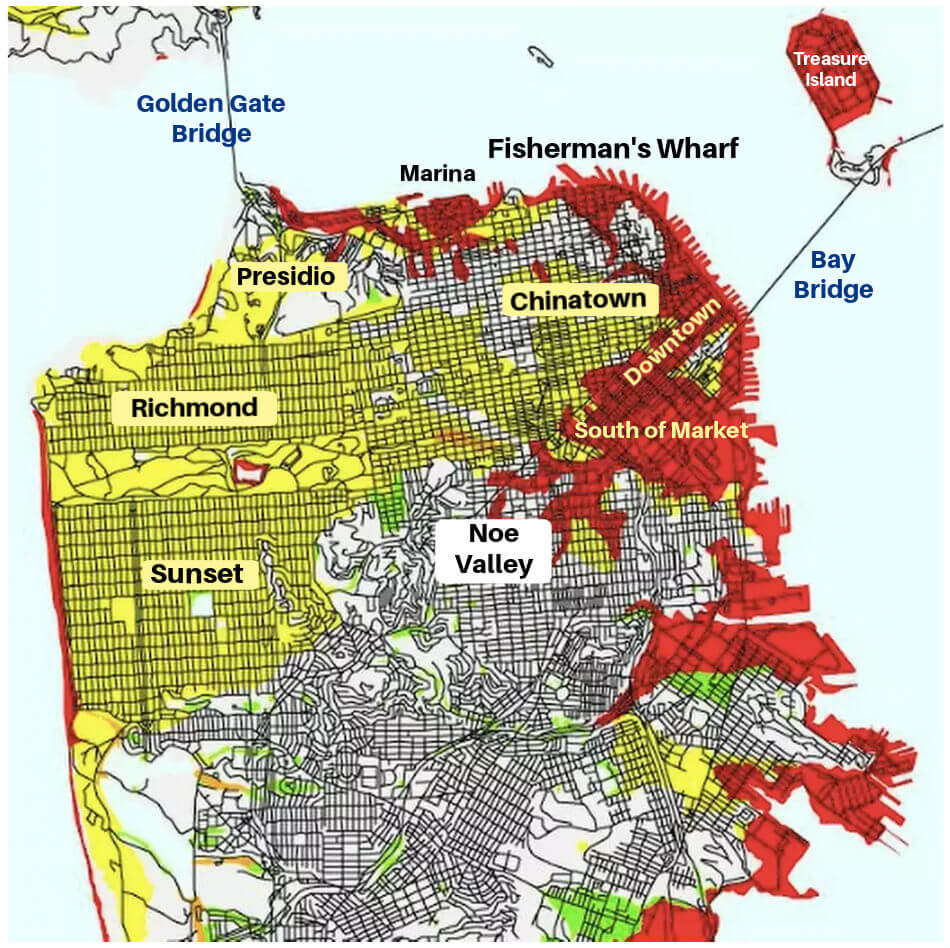
The U.S. Geological Survey map of liquefaction susceptibility for San Francisco.
Red: very high risk
Orange: high risk
Yellow: moderate risk
Green: low risk
White: very low risk
During the 1989 Loma Prieta quake, areas like the Marina District experienced a lot more damage than neighborhoods like Twin Peaks or Noe Valley, which have rock under them.
The Marina, the Mission, Fisherman's Wharf, the Embarcadero, downtown, and South of Market areas were built on landfill, so the shaking is more severe. Liquefaction can occur which makes it even worse.
And the neighborhoods out in the western area of SF, towards the beach, like the Richmond and Sunset Districts, were built on sand dunes, are also unstable, but not as bad as the landfill areas.
I've noticed that even small quakes like 2.0 or 2.5 were much more noticeable out in the Sunset District where I was living later on, compared to Noe Valley. Those would have been almost unnoticeable in Noe Valley.
My earthquake experience: Loma Prieta
I was living in the Noe Valley neighborhood of SF at the time of the 1989 quake and my office was also in Noe Valley.
The building started to shake and I found a doorway inside the office to stand in (the advice given at that time; now it's get under a table!). As I was standing there, the shaking suddenly got a lot stronger and I decided to get out of the building. I stood outside in the street and watch the parked cars bobbing up and down!
It was quickly over, and I went inside and everything looked okay. Nothing had fallen over or off the shelves, so I didn't think it was a major quake. Then on the radio we heard that a section of the Bay Bridge had fallen and the freeway in Oakland had collapsed! And that buildings had fallen and fires were burning in the Marina District. Our electricity went out as well, but returned around 11 pm that night.
Other areas of the city weren't so lucky. Downtown San Francisco and some other areas didn't get their power back for three days.
After the power came back on that evening, I was able to watch the news showing scenes of destruction in SF and the East Bay, and the one horrible video they showed over and over of a car on the Bay Bridge falling down to the lower deck of the bridge (the driver was killed).
An elevated section of a major freeway in Oakland collapsed and killed a lot of people. The earthquake hit just after 5 pm, minutes after the third game of the World Series had started in Oakland!
My cousin would have been on that freeway at that time but she had gone home early that day to watch the World Series. A number of others had done the same, or even more people could have been killed on that freeway.
 Cypress Freeway collapse in Oakland
A few days later, I went to look at the Marina District and saw that a number of the soft-story buildings had been seriously damaged. Even some of the sidewalks had folded and broken up.
 Marina District damage, soft-story building
A real motivation to have earthquake bracing done on my soft-story, Sunset District house!
Curious about what an earthquake feels like?
You can actually get a feel for what a 7.0 or 8.0 earthquake feels like at the California Academy of Sciences Museum in Golden Gate Park.
They have a mini SF Victorian set up where you can experience a 7.0 level of shaking, followed by an 8.0 level earthquake. Check out the Shake Shack; pretty cool!
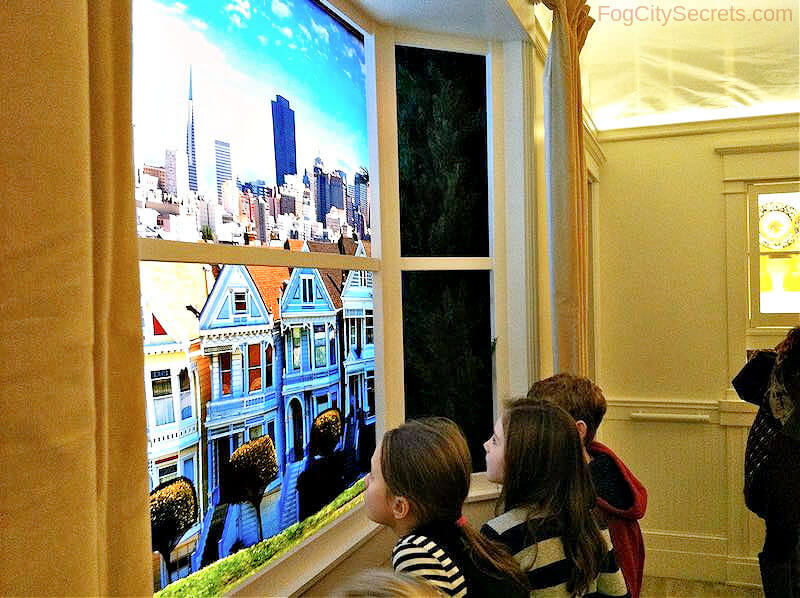 Hang on tight!
More San Francisco travel tips:
- Best areas to stay in San Francisco
- Best time to visit
- Top attractions
- Fun things to do
- Getting around SF
Share this page:
Welcome to San Francisco!
 My son Alex and I, waiting for the Sausalito Ferry
Hi, I'm Karen. I was born just across the Bay, and spent over 30 years in San Francisco, but the City still casts its spell over me.
Here's our guide to SF and beyond, with lots of local tips!
Latest pages...
Visit the beautiful Depression Era Coit Tower murals. Get a glimpse of San Francisco circa 1934, political controversies and all!
Explore one of the most charming neighborhoods in SF, Noe Valley. Still "undiscovered" by tourists in the city. My old neighborhood!
Should visitors to SF be concerned about earthquakes? Not really, but here's what you need to know about Bay Area earthquakes.
Admire some great views from a hidden park, Ina Coolbrith Park, on Russian Hill.
See one of San Francisco's best and most-overlooked viewpoints, Grandview Park on Turtle Hill.
Explore my longtime neighborhood, the Sunset District, out by the ocean.
Renting a car at SFO? Handy tips, good things to know.
Is SFMOMA worth a visit? Definitely! It's a fun place to explore, even if you don't like "modern" art.
How to visit San Francisco on a budget. Yes, it can be done!
Stumped for a souvenir? Check out my suggestions for out-of-the-ordinary San Francisco souvenirs.
Climb Telegraph Hill on the Filbert Steps. Hidden gardens and pretty views!
Explore the Lyon Street Steps. Climb the Lyon Street Stairs for great SF views...and a workout.
Local artists paint wonderful San Francisco scenes! See San Francisco art.

Get the latest tips on visiting San Francisco.
SF Bus, BART & Cable Car Routes

Home | Sitemap | Contact Me | About Me
Privacy Policy | Use Policy | Affiliate Disclosure
As an Amazon Associate I earn from qualifying purchases.
FogCitySecrets.com
Inside-Guide-to-San-Francisco-Tourism.com
Copyright© 2009-. All rights reserved.