The Coit Tower Murals
A Guide for Visiting the Murals

Fascinating, Depression-Era art decorates the inner walls of San Francisco's Coit Tower.
I love the time-capsule vision of California in 1934: the industry, agriculture, every day life, and the city itself, in a challenging period for San Francisco and the nation.
Coit Tower sits high on Telegraph Hill and gives visitors one of the best views of San Francisco and beyond. The views are spectacular, but the murals are just as interesting.
The first time I went inside Coit Tower, I thought the murals were beautiful, but it was hard to appreciate all the details in the works on a stroll through the building.
After I read up on the history and the art works themselves, subsequent visits were even more intriguing. The Coit Tower murals were extremely controversial when they were first created.
I highly recommend taking one of the tours so you have access to the murals on the second floor.
I've tried to create a more in-depth guide to the murals, the artists and the content of the works that you can see when you visit Coit Tower.
Jump to:
Tips on viewing the murals...hours, fees, tours.
Visiting the Coit Tower murals
Best way to see the murals
Ground floor murals. Most of the murals are on the ground floor, and entry is free. The ground floor is open whenever Coit Tower is open.
To see the murals on the stairway and the second floor, you have to take a tour. There are two tour options.
- Coit Tower docent tour ($5-$10)
- SF City Guides tour (free)
Hours, fees, & tours
Open daily. April-October: 10-6. November-March: 10-5. Closed some holidays.
Ground floor murals: entry is free
Stairs and second floor murals require a tour.
Coit Tower docents give tours for groups of 4 to 6 people. $5 for just the second floor, $10 for all the murals. 30-40 minutes. Tickets are sold at the tower.
The SF City Guides organization gives free tours of all the murals. These are highly-regarded tours done by volunteers. 1.5-2 hours. I went on this one a few years ago and it was excellent. Check their schedule. Must sign up on their website, SF City Guides.
To go to the top of the tower for the spectacular views, you can buy a ticket for the elevator (when it's working - they've been having problems with it). Or walk up the 15 flights!
See SF Parks for current info.
Getting to Coit Tower
By bus: the 39-Coit bus has stops in Fisherman's Wharf and near Union Square, and drops you right at the entrance to Coit Tower. See 30-Coit for route and stops.
By car: there is a small, free parking lot at the top of Telegraph hill at Coit Tower. There is a 30 minute limit which is sporadically enforced. There's a couple of decent parking garages nearby:
- Levi's Garage, 1426 Sansome St.
- ParcTel Garage, 1603 Montgomery St.
You can walk there from the Embarcadero if you're in the mood for a scenic climb. See Filbert steps. Or walk from North Beach to the end of Lombard Street.
Where are the murals?
Coit Tower has two floors covered with murals, plus a staircase connecting the floors that is also decorated with murals.
Ground floor: As you enter the tower, you can walk all the way around the lobby. The entire wall space is decorated with murals. The themes include California agriculture, industries, shops, libraries, and more.
Also, when you enter and look straight ahead, you'll see a doorway into a smaller room which is the lobby for the tower elevator. This smaller lobby has oil paintings of Bay Area scenes decorating the walls.
The stairway: There is a curving stairway that leads up to the second floor. This connecting staircase has murals on both sides to see as you walk up, with city scenes representing Powell Street near Union Square.
The second floor: There are more murals to see on the wall of this level. Frescoes show outdoor activities, such as sports, hunting, children playing, and some unusual indoor scenes.
History of the Coit Tower murals
Coit Tower was built in 1933, financed by a bequest from Lillie Hitchcock Coit, one of San Francisco's more unique characters.
A Depression Era project. The murals decorating the inner walls of the tower were the product of the Public Works of Art Project (PWAP), a program to employ artists and boost morale during this difficult period.
All of the artists working on the Coit Tower murals were employed by the PWAP, and the murals were completed in just six months in 1934.
Historical context of the murals: the PWAP and WPA
After the 1929 stock market crash, unemployment in the U.S. rose from under 4% to a peak of 25% in 1933.
In 1933, President Roosevelt created the Public Works of Art Project as part of his New Deal plan, and in 1935, he created the Works Progress Administration (WPA) to give jobs to Americans, building infrastructure like roads, schools and hospitals. The program also paid artists, musicians, actors, and others to produce creative works, giving them employment while also boosting public morale.
The artwork was supposed to reflect the goals of the New Deal program and also to show scenes of daily life in America at the time.
The President's advisors had been impressed by the Mexican murals created in Mexico City by Diego Rivera and others, and wanted to use a similar style to illustrate life in America. Advocates for a more traditional, classical painting style lost the battle over artistic direction, and the "modern", worker-centered format won out.
Artistic style
Social Realism. You'll notice a similarity of style in the Coit Tower murals. The human figures are solid and bulky, and often dressed in workers' clothing.
They are shown performing various trades or other forms of manual labor. Many murals are urban scenes but there are also farmers and other scenes from agriculture. The style is usually called social realism; the "masses" are presented in their work clothes and their faces tend to be solid and serious.
Diego Rivera was well known at the time for his murals in public areas of Mexico City, and the style used in the Coit Tower murals was clearly influenced by his works.
 Trotsky, Engels & Marx, by Diego Rivera
The painting above is a section of a fresco in Mexico City, called Man, Controller of the Universe. This same scene was also in Rivera's fresco at Rockefeller Center in New York.
The one in New York was destroyed before it was completed on the orders of Nelson Rockefeller, who saw it as propaganda for communism instead of the planned contrast between capitalism and socialism. Rivera's addition of Lenin into the painting was the flashpoint; Rivera refused to remove it, and in 1934 the whole mural was destroyed.
Rockefeller had wanted the mural to be done by Matisse or Picasso, but they weren't available, and his mother suggested Rivera, whose work she admired.
See more information on this at diegorivera.org.
Bernard Zakheim included a newspaper referring to this event in his Library fresco in Coit Tower.
Consistency amongst the artists. The decisions about the content and style of the murals were made by a local committee appointed by the federal agency directing the public art projects.
The head of the committee, Dr. Walter Heil, was particularly influential in choosing the style and subject matter for the murals. He was a big fan of fresco-style murals and decided that the Coit Tower murals would be done using fresco techniques.
The scale of the figures in all of the paintings was set so that they would be more or less the same size, and an earth-tone palette was established that all of the artists were supposed to follow, at least for the frescoes which make up most of the murals in the tower.
He was planning for these art works to last.
"There is no reason why Coit Memorial Tower with its mural paintings should not stand five hundred to one thousand years from now, a monument to this epoch and to the artists who worked on it."
Dr. Walter Heil
Dr. Heil chose Victor Arnautoff to be in charge of the painting at Coit Tower, because of his extensive experience studying mural-making in Mexico with Diego Rivera, who also created some murals in San Francisco that are currently not open to the public.
Arnautoff created one of the most popular scenes in the tower, the San Francisco city scenes on the ground floor, City Life.
 City Life, by Victor Arnautoff
Arnautoff was a member of the Communist Party at the time, which was not uncommon among the artists working here. He included leftist newspapers in the mural, The New Masses and the Daily Worker, which contributed to the political controversy over the Coit Tower murals. The City Lights sign refers to the Charlie Chaplin film, not the bookstore.
This style has been compared to the socialist realism style of Russia and Germany during the 1930s, but it doesn't display the idealization of the workers with perfect looks and bodies - the worker as hero - that was illustrated by Stalinist and Nazi art of the time.
Many of the people in the murals are portraits of real individuals, either artists working on the murals or others associated with the public works projects.
Political controversy: communism in the tower?
The works produced by the visual artists in this program often reflected their political views.
Many of them were sympathetic to the leftist movements in the world at the time. It was the height of the Depression. Some were members of the Communist Party or sympathetic to communism, while others were simply concerned with the struggles of the unemployed and the difficult working conditions of blue-collar workers in the cities.
Political tensions came to a head in San Francisco in 1934, at the same time the murals were being created. There was a longshoreman's strike in San Francisco that erupted into violent clashes.
The strike causes a complete cessation of port activity all along the West Coast, from San Diego to Seattle, and it went on for months. There was concern that the leftist themes in the murals would inflame an already tense situation.
Some of the murals have obvious references to communism, like the copy of Das Kapital by Karl Marx in the Library mural, which created heated commentary in the local papers.
One of the artists, Arnautoff, retaliated by excluding the San Francisco Chronicle in a newspaper rack in the City Life mural and by including a couple of radical papers, The New Masses and the Daily Worker.
Another of the artists, Wight, had included a hammer and sickle in a painting, as well as "Workers of the World Unite". That was too much for Dr. Heil, who was in charge of the project, and those offending items were removed, but the others remain.

Creating the Coit Tower murals
How to create a fresco.
The Coit Tower frescos were created using a tradional method also used by the muralists in Mexico.
A layer of cement was used to cover the wall, then a layer of lime plaster covered the cement. That layer was allowed to dry, and the artist drew a rough sketch of the future painting on the wall.
The day the section was to be painted, a thin layer of lime plaster mixed with finely ground marble was applied to the wall's surface.
The artist worked on one small section at a time, roughly 2 feet by 2 feet, because the paint had to be applied when the plaster was still wet. At most, the plaster could stay wet for 12 hours.
The paint pigments were ground and mixed for use by only one assistant so that all the artists were using the same paints and colors.
The paint becomes part of the wall in this technique and makes it more difficult to repair surface scratches or missing chunks.
Oil paintings and tempera paintings in Coit Tower
All the wall paintings in Coit Tower are in the fresco buono (wet) style, with two exceptions:
- The paintings in the elevator lobby, over the elevator door, and in the recesses are oil paintings.
- The family home line drawings on the walls in one of the second-floor rooms are done with egg tempera paint.
The oil paintings were done in the artists' studios and installed later.
Jane Berlandina is the artist who created the interesting family scenes in a small room on the second floor, using egg tempera paint applied to dry plaster, called fresco secco (dry fresco). Her style is quite different from the rest of the frescoes.
Vandalism in the tower
The Coit Tower murals, including the works on the stairway and second floor, were open to the public without supervision from 1934 until 1960.
Unfortunately, many of the paintings were vandalized. So in 1960, access to the murals was closed and not reopened until 1977, after they were restored.
The artists of Coit Tower
A total of 24 artists created the murals and other paintings in Coit Tower.
They needed the assistance of other workers as well, who were also artists, due to the labour involved in creating and applying the plaster for the murals and preparing the paint.
Some of the more prominent artists working at Coit Tower:
Victor Arnautoff
Victor Arnautoff was placed in charge of the artists working at Coit Tower, and he contributed one of the most popular murals, City Life.
His City Life mural is on the ground floor and is a fascinating view of the people and streets of San Francisco in 1934.
Arnautoff had an interesting life. He was born in 1896 in a town in the Russian Empire, now in Ukraine, the son of a Russian Orthodox priest. He served as an officer in the White Russian army of Czar Nicholas II and escaped in to China after its defeat. In China, he trained the cavalry of a Chinese warlord.
In 1925 he moved first to San Francisco and then to Mexico in 1929. While in Mexico, he worked with Diego Rivera on the murals being created in public buildings there.
In Mexico, he met one of the other Coit Tower artists, Bernard Zakheim. By this time, both artists had become involved in leftist movements. Arnautoff joined the Communist Party in 1937.
Arnautoff returned to San Francisco in 1931 and began producing a large collection of murals around the Bay Area. One of his large murals is on a stairway at George Washington High School in San Francisco.
This large mural's subject is George Washington's life and was in the news several years ago over an unsuccessful attempt to remove the mural because of its depiction of slaves and a dead Indian. It was a close call; the school board initially voted to have it painted over, but a public outcry stopped them. Three of the board members were recalled later. See the SFGATE article about the controversy.
This same mural was almost removed in 1968 for the same reasons, but a compromise was reached, and another series of murals representing the disadvantaged was added instead.
His City Life mural aroused some controversy because he put himself in the painting, standing next to a newspaper rack with several leftist publications, and left out the then-conservative (!) San Francisco Chronicle.
Arnautoff taught art at both the California School of Fine Arts and Stanford University.
More information on Arnautoff's life:
Interesting article on Arnautoff in the Stanford Historical Society magazine.
 City Life, by Victor Arnautoff
Bernard Zakheim
Bernard Zakheim was born into a Hassidic Jewish family in Warsaw and moved to San Francisco with his wife in 1920. He worked as a furniture maker and lived in the Fillmore district.
He went to Mexico and studied with Diego Rivera, where he met Victor Arnautoff, and later studied in Paris.
He created the mural at Coit Tower entitled Library, which aroused controversy by showing a fellow artist pulling the book Das Kapital by Karl Marx off a shelf. Zakheim was also a member of the Communist Party.
The San Francisco Examiner newspaper published a picture of the Library mural which showed someone reading a newspaper article about the destruction of one of Diego Rivera's murals, Man at the Crossroads, because of its communist themes. This, along with other leftist themes in the murals, triggered a temporary cessation of the Coit Tower work and a lockout of the public.
 The Library, by Bernard Zakheim
Kenneth Rexroth is on the ladder; he was an author of erotic poetry (one of his books is on the shelves) and he also painted. He was involved in the anarchist movement and was named "Father of the Beats" by Time magazine.
The girl in the sailor blouse is Zakheim's daughter, and the artist himself is the fellow in blue on the lower left, reading a book in Hebrew.
The man holding Das Kapital is artist John Langley Howard, who painted the California Industrial Scenes mural with the striking miners.
 From California Industrial Scenes, by John Langley Howard
Ralph Stackpole (Industries of California) is reading a newspaper article on the destruction of Rivera's fresco at Rockefeller Center.
 Headlines from 1934. From Library, by Bernard Zakheim
 Industries of California, by Ralph Stackpole
Jane Berlandina
Jane was the wife of the architect who designed Coit Tower, Henry Howard, and an established painter herself. She was from Nice, France, studied art under Raoul Dufy, and had a very different style from Diego Rivera's stocky figures, which appear in most of the Coit tower murals.
She used a different technique as well. Her mural was created with egg tempera instead of fresco or oil and covered three walls of a room on the second floor with interior scenes of people at home. Hence the title, Home Life.
There are people dancing, a woman baking bread, someone playing the piano, and a group playing bridge. Berlandina put herself in one of the scenes; she is standing and looking down at the bridge players.
 From Home Life, Jane Berlandina
The Lobby Murals - ground floor
The murals on the ground floor include:
- Animal Force, by Ray Boynton
- California Industrial Scenes, by John Langley Howard
- Railroad and Shipping, by William Hesthal
- Surveyor and Steelworker, by Clifford Wight
- Industries of California, by Ralph Stackpole
- Newsgathering, by Suzanne Scheuer
- Library, by Bernard Zakheim
- Stockbroker and Scientist-Inventor, by Mallette Dean
- City Life, by Victor Arnautoff
- Banking and Law, by George Harris
- Department Store, by Frede Vidar
- Farmer and Cowboy, by Clifford Wight
- California, by Maxine Albro
- Meat Industry, by Ray Bertrand
- California Agricultural Industry, by George Langdon
Some examples:
California Industrial Scenes, by John Langley Howard
 From California Industrial Scenes, by John Langley Howard
The small scene by the tent in the upper right contrasts the migrant farmers' camp and old truck with the affluent visitors with their chauffeur-driven fancy car.

 Miners' faces, John Langley Howard
Railroad & Shipping, by William Hesthal
 Signalman and boat, from Railroad & Shipping
Industries of California, by Ralph Stackpole
 Assembly line workers from Industries of California
Library, by Bernard Zakheim
From the Library mural (see images above), some of the books include works by classic authors like Oscar Wilde, Daniel Defoe, Henry Fielding, Jonathan Swift, Ernest Hemingway, William Faulkner, and Anton Chekhov.
Other shelves contain some left-leaning authors of the 1930s, such as John Strachey (Theory & Practice of Socialism), Granville Hicks (Communist Party member and editor of The New Masses), Grace Lumpkin (Communist organizer and writer for The New Masses), Stuart Chase (books praising the Soviet system and the New Deal), and Kenneth Rexroth (anarchist and poet).
 From the Library, by Bernard Zakheim
City Life, by Arnautoff
City Life is one of the most popular murals at Coit Tower because it shows city scenes of San Francisco.
 From City Life, by Victor Arnautoff
This is a lively scene of downtown San Francisco, with a robbery, a car accident, and lots of people in 1930s clothing styles, which is fun to see.
This mural is the one with the newspaper and magazine racks showing local newspapers of the time, along with copies of Harpers, House Beautiful, Vanity Fair, and Esquire.
The Department Store, by Frede Vidar
It looks like a nice group of shops and a soda fountain, in spite of the glum expressions on the ladies' faces.

Soup for 5 cents and chile con carne for 15 cents. For reference, the top artists here were making $1 per hour at the time.
 Ladies at the soda fountain in The Department Store, by Frede Vidar
Cowboy, by Clifford Wight
 The Cowboy, by Clifford Wight
The Cowboy was one half of a pair of paintings on either side of a window. The Farmer was on the other side. He did another pair of paintings flanking another window on the ground floor, Stockbroker and Steelworker.
It was Wight who caused the biggest uproar by including a hammer and sickle and the phrase "Workers of the World Unite" over a doorway. These were the only leftist items removed before the murals opened.
California, by Maxine Albro
Maxine Albro's California mural includes a variety of agricultural scenes common to the state, such as Napa and Sonoma vineyards and wineries, oranges, flowers, dairies, and almond orchards.
 From California, by Maxine Albro
The elevator lobby murals - ground floor
There is a small room on the ground floor, straight ahead as you enter the tower, where the elevator is located. It leads to the viewing area at the top of the tower and has been decorated with a series of oil paintings fitted into the recesses.
This is cool because two of these paintings would be the views from windows if you could see out there (and if they were higher, of course).
One painting, San Francisco Bay, shows a view across the bay to the east, including the San Francisco waterfront, Yerba Buena Island, and the Berkeley and Oakland hills.
The other one, San Francisco Bay North, shows the view north toward Marin County, including where the Golden Gate Bridge would be, as well as Alcatraz Island. The piers on the Embarcadero are at the bottom.
These paintings represent the bay views as they would have looked in 1934, before the Golden Gate Bridge and Bay Bridge were built. The Golden Gate Bridge was finished in 1937. Alcatraz Prison had just opened for maximum-security prisoners in 1933.
The other two paintings show views of the farmland and rolling hills of the East Bay and Santa Clara Valley, respectively.
There are also two semicircular works above the doors showing seagulls and pelicans.
 San Francisco Bay, North, by Jose Moya del Pino
Coit Tower's "secret" murals
For most of Coit Tower's existence, the public was allowed only into the ground-floor area and the viewing area at the top of the tower.
The second floor was closed off by a double door and visitors missed out on seeing some of the wonderful murals that climb the staircase and cover the walls on the second floor.
Only in 2014, after they were restored, was the public allowed to see them. Even now, because the stairway is narrow and the space upstairs is a bit cramped, visitors have to be part of a tour to see them.
Are they worth seeing? Absolutely! The stairway mural is a city scene of Powell Street in 1934 and is one of my favorites. The second-floor murals are more lighthearted and upbeat than the somewhat somber scenes below of industry and agriculture.
I highly recommend arranging for one the tours, either the Coit Tower docent tour or the free tour given by SF City Guides.
See the SFGATE article about the 2014 opening.
The stairway murals - between the floors
Powell Street, by Lucien Labaudt
This is another very popular mural, illustrating busy city life on Powell Street in downtown San Francisco, which connects Nob Hill and Union Square with Market Street. It's actually two murals, one on each side of the stairway, so Powell Street is on both sides of you as you climb the stairs.
 Powell Street, by Lucien Labaudt
Again, many of the people in the murals are portraits of actual people, friends and acquaintances of the artist. You can see the cable car kiosk on Nob Hill, the cable cars, and the Art Deco gem at 450 Sutter Street (my dentist's office!) which is still there.
 450 Sutter Street, Powell Street mural
Lucien Labaudt also painted the murals at the Beach Chalet at Ocean Beach in San Francisco, which are also worth seeing, as well as a mural at George Washington High School.
 Beach scene at Beach Chalet, by Lucien Labaudt
Second floor murals
Most of the murals on the second floor are more upbeat outdoor scenes involving play and leisure activities.
- Collegiate Sports, by Parker Hall
- Sports, by Edward Terada
- Children at Play, by Ralph Chesse
- Hunting in California, by Edith Hamlin
- Outdoor Life, by Ben F. Cunningham
- Home Life, by Jane Berlandina
Some examples:
Ralph Chesse
 Children at Play, Ralph Chesse
Edith Hamlin
 Hunting in California, by Edith Hamlin
Ben F. Cunningham
 Outdoor Life, by Ben F. Cunningham
Jane Berlandina
Jane Berlandina's frescoes. Berlandina was the wife of the Coit Tower architect, Henry Howard, and had studied in Paris with artists Henri Matisse and Raoul Dufy. She was also a set designer for the San Francisco Opera.
She decorated all four walls of a small room upstairs with scenes of family life. Her painting style uses outlines and a dark, brownish palette, and is quite distinct from the other frescoes.
Home Life, by Jane BerlandinaMore WPA murals in San Francisco
San Francisco has a rich collection of these WPA Murals, scattered over a number of locations in the city.
- The Beach Chalet, at Ocean Beach
- Rincon Center, at 121 Spear Street downtown
- Aquatic Park, at Fisherman's Wharf
The Beach Chalet
The Beach Chalet is a nice restaurant on the edge of Golden Gate Park, across from Ocean Beach. It has some beautiful murals from the 1930s in the lobby.
Entry is free if you just want to see them, but why not try one of their beers while you're there, brewed on the premises? You can sit upstairs in the restaurant with a nice view of the ocean or in outdoor seating in back.
 Beach Chalet mural, by Lucien Labaudt
Lucien Labaudt also painted the Powell Street murals.
Rincon Center
Rincon Center has a huge room with 27 fascinating murals by Anton Refregier, titled History of San Francisco, also in the social realism style.
Scenes include the Spanish fathers at the missions, Indians, gold miners, labor unrest, and scenes reflecting some of the darker history of the state. These murals were almost destroyed in 1953, again because of perceived pro-communist messaging.
There's also a great dim sum restaurant, Yank Sing, in the same building at 121 Spear Street.
 Spanish soldiers at Rincon Center, by Anton Refregier
Aquatic Park, Maritime Museum
Aquatic Park at Fisherman's Wharf was another Depression-era project with a bathhouse, beach, and stadium built for public enjoyment on the waterfront.
 Atlantis mural in Maritime Museum
The Maritime Museum at Aquatic Park is worth a visit and has some beautiful murals featuring sea life swimming around buildings of a submerged Atlantis, by artist Hilaire Hiler.
 Maritime Museum lobby
There are also some colorful tile murals with pretty sea themes on the rear wall of the building, by artist Sargent C. Johnson.
The museum is free and is just across the street from Ghirardelli Square.
 Tile murals by Sargent C. Johnson
Murals not open to the public
There are lots more Depression-era murals in San Francisco, but unfortunately the ones listed below aren't open to the public. The Mission High School and George Washington High School murals can be seen by appointment. Many of the artists were also contributors to the Coit Tower murals.
Mission High School. There are two long murals by Edith Hamlin illustrating life at the nearby Spanish mission, Mission San Francisco de Asis, just up the block from the school. One of the murals shows the construction of the mission. Hamlin was the artist who painted Hunting in California at Coit Tower.
George Washington High School. This Richmond District high school contains a number of large WPA murals. Victor Arnautoff painted The Life of Washington, which has caused controversies over the years because of his depictions of African slaves and deceased Indians. Other murals in the school include Gordon Langdon's Modern and Ancient Science, Ralph Stackpole's Contemporary Education, Lucien Labaudt's Advancement of Learning Through the Printing Press, and Sargent C. Johnson's bas-relief frieze Athletics, located outside on the playing field.
San Francisco Zoo. There is a collection of WPA murals and mosaics in a building at the zoo that is closed due to earthquake issues.
Diego Rivera Murals. There are three of his murals in SF, but at the moment, none of them are available for public viewing.
Sources for Coit Tower mural information
There are a couple of excellent reference works about the Coit Tower Murals (with Amazon links).
Coit Tower San Francisco, Its History and Art, by Masha Zakheim Jewett. 1983. The author is the daughter of one of the Coit Tower artists and has written a fascinating and comprehensive guide to the murals.
Depression-Era Murals of the Bay Area, by Veronico, Morello, Casadonte and Collins. 2014. Includes the murals at the Beach Chalet, Rincon Center, Aquatic Park, local high schools, and more, as well as the Coit Tower murals.
Share this page:
Welcome to San Francisco!
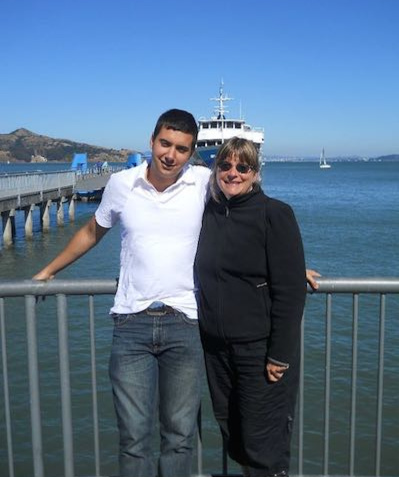 My son Alex and I, waiting for the Sausalito Ferry
Hi, I'm Karen. I was born just across the Bay, and spent over 30 years in San Francisco, but the City still casts its spell over me.
Here's our guide to SF and beyond, with lots of local tips!
Latest pages...
Visit the beautiful Depression Era Coit Tower murals. Get a glimpse of San Francisco circa 1934, political controversies and all!
Explore one of the most charming neighborhoods in SF, Noe Valley. Still "undiscovered" by tourists in the city. My old neighborhood!
Should visitors to SF be concerned about earthquakes? Not really, but here's what you need to know about Bay Area earthquakes.
Admire some great views from a hidden park, Ina Coolbrith Park, on Russian Hill.
See one of San Francisco's best and most-overlooked viewpoints, Grandview Park on Turtle Hill.
Explore my longtime neighborhood, the Sunset District, out by the ocean.
Renting a car at SFO? Handy tips, good things to know.
Is SFMOMA worth a visit? Definitely! It's a fun place to explore, even if you don't like "modern" art.
How to visit San Francisco on a budget. Yes, it can be done!
Stumped for a souvenir? Check out my suggestions for out-of-the-ordinary San Francisco souvenirs.
Climb Telegraph Hill on the Filbert Steps. Hidden gardens and pretty views!
Explore the Lyon Street Steps. Climb the Lyon Street Stairs for great SF views...and a workout.
Local artists paint wonderful San Francisco scenes! See San Francisco art.

Get the latest tips on visiting San Francisco.
SF Bus, BART & Cable Car Routes
Home | Sitemap | Contact Me | About Me
Privacy Policy | Use Policy | Affiliate Disclosure
As an Amazon Associate I earn from qualifying purchases.
FogCitySecrets.com
Inside-Guide-to-San-Francisco-Tourism.com
Copyright© 2009-. All rights reserved.